


IMPORTANT NORMI DEFINITIONS
Nanotechnology -- A nanometer is one-billionth of a meter... it is at the MOLECULAR level.
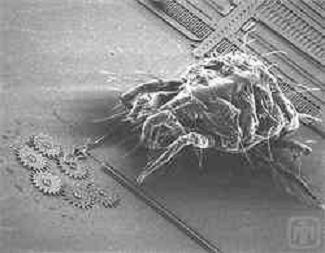
A sheet of paper is about 100,000 nanometers thick. Products now exist that encompass nano-scale science, engineering and technology. Nanotechnology involves imaging, measuring, modeling and manipulating matter at this scale [smaller than visible by microscope]. Using this technology molecules can be constructed to do work that could not be done on a larger scale. More information is available at http://en.wikipedia.org/wiki/Nanotechnology .
Mold-Free -- HARDLY ANYTHING is 100% Mold-Free (that would be "sterile"), however, based on pre- and post-sanitization screenings, an indoor environment can be dubbed "Mold-Free" when the post-screening shows levels of mold, mildew, or bacteria to be in the "normal/expected" ranges (based on EnviroScreening Mold Reports) www.MoldFreeConstruction.com
Sanitization Protocol -- A system whereby an indoor environment can be "sanitized" using products, techniques, and a lifestyle that will keep "Mold-Free" levels consistently low. "Sanitized" means the microbial population, when referencing a baseline screening, has been reduced.
Microbe -- A microorganism; a disease producing bacterium.
Antimicrobial -- Something that serves to reduce microbial growth. Antimicrobials, enzyme cleaners and other biocides are an effective way to clean surfaces of microbes such as mold, mildew, bacteria, germs, virus, fungus.
Protectant -- A product that, when placed on a surface, protects that surface from microbial growth; provides a long-lasting barrier [3 months per application or longer on some substrates] without leaching chemicals; not removed by fresh or salt water nor by UV light.
Micropuncture Technology -- Scientifically known as Quatenary Reactive Organo Siloxane technology ... operates at a microscopic level by solubilizing [puncturing and melting] a microbe's cell wall. Once this occurs the microbe can no longer support life function. This technology is available in both durable and non-durable forms in Microbloc DSP, BSD and MSE products. Through numerous third party laboratory tests, efficacy has been shown to be as high as 99.9990% in inhibiting fungi, bacteria, algae, viruses and protozoa.
Incremental Approach -- A common sense approach to solving indoor air quality and surface contamination problems by recognizing that every step along the way toward a "Mold-Free" environment, though incremental, is a step in the right direction. This approach understands that limited resources, knowledge or access may demand a long-term solution to air and/or surface contamination.
Superbugs -- Commonly understood as germs that have mutated or evolved to defend themselves against existing antibiotics used to kill them. Under this classification falls such biologicals as VRE [strep ... Vancomycin-Resistant Enterococcus] and MRSA [staph ... Methicillan Resistant Staphylococcus Aureus) among others. These two organisms were once found mostly in health-care facilities but are now showing up in gyms, locker rooms, whirlpools, hot tubs and other areas frequented by the general public; 25% of the public is suspected to be a carrier ... on skin and/or in noses. MRSA is known for its flesh eating nature ... is also known for causing death and amputations.

Surface Preparation -- an important procedure to follow before applying a protectant; surfaces should be dry and clean of dirt and wax or other coatings [excludes paint and urethanes].
Product Information Sheet [PIS] -- generally a 2 page summary of the attributes of a product ... available for download at the www.NORMI.org website in the Member section.
Material Safety Data Sheet [MSDS] -- every company that manufactures or distributes hazardous chemicals in the United States must prepare a Material Safety Data Sheet as mandated by the Occupational Safety and Health Administration (OSHA). The purpose of this OSHA standard is "to ensure that the hazards of all chemicals produced or imported are evaluated, and that information concerning their hazards is transmitted to employers and employees." Such sheets that identify the handling, storing and use of Microbloc Surface Preparation and Protection Products, approved by NORMI for use by NORMI Certified Professionals, are available for download at the www.NORMI.org website in the Member section and should always be provided to prospects and customers. NOTE: Microbloc products approved by NORMI for use by NORMI Professionals are not considered to be "hazardous" by either Microbloc or NORMI.
Certified Biocide Applicator [CBA] -- a professonal designation awarded to an individual who successfully completes NORMI training on the use and application of antimicrobials.
Certified Mold Inspector [CMI] -- a professional designation awarded to an individual who successfully completes NORMI training on mold inspection ethics and protocols.
Certified Mold Remediator [CMR] -- a professional designation awarded to an individual who successfully completes NORMI training on the protocols for the safe removal of mold from structures and the reconstruction of those structures.
------------
Newscast 4 with Doug Hoffman, NORMI Executive Director -
Louisiana licensing of Mold Professionals ... DIY Mold Test Kit available online
DIY precautions for homeowners ... NORMI recommends a biocide to kill mold to its roots
NORMI is the Official Louisiana Trainer of Mold Remediators.
www.5047.com/mold/doug1.html
------------