|
 
ATP LUMINOMETER SCREENING
[Lumin - omm - eter]
ATP
All living organisms have a substance called Adenosine Triphosphate (ATP) which links
most cellular chemical reactions. Energy is trapped and stored in the form of ATP.
To obtain energy to do cellular work, organisms take energy-rich compounds,
such as glucose, into their cells and enzymatically break them down
to release their potential energy.
PRACTICAL DESCRIPTION
A firefly produces an enzyme in its tail ...when mixed with his ATP, his tail lights up in
the darkness. This luminescence is measurable and the ATP Luminometer can quantify the
amount of ATP present. A Luminometer cannot IDENTIFY any organism but it can certainly
measure the level of contamination.
The SystemSURE II ATP Luminometer
This bio-luminescense detector luminometer is the next generation of ATP luminometers.
Using state-of-the-art photodiode technology and simple user-friendly design this
revolutionary palm-sized instrument is an extremely sensitive, accurate and affordable
hygiene monitoring system. The systemSURE II is used to quickly determine the hygienic
status of a surface after pre-operational cleaning or to monitor the effectiveness of a
sanitation program. It can also be used to monitor water quality. Used with the
Ultrasnap ATP sampling swab, extremely low levels of contamination can be detected
in just 15 seconds. This allows immediate action to be taken which assures brand
protection, cost reduction, food safety and quality.
Hygiena [high-g-na] Electronic Luminometer [lumin-omm-eter]
www.hygienausa.com/demos-01/ss2/intro-02a.html
METHODOLOGY
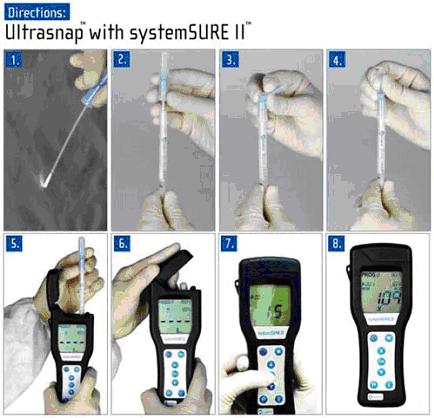
Using the Ultrasnap swab - swab a 4"x4" (16 square inches) area ... break the "reagent"
container ...shake the swab 5 sec. before placing it into the ATP Luminometer. This
pre-screening reading indicates a level of contamination without identifying what the
contamination is. After applying the NORMI Approved Protectant [DSP, MSE, FSP, MSP] to
the surface, a post-screening using the same Ultrasnap System will often show
a substantial reduction in surface bacteriological contamination.
This is why MicroPunctureİ Technology is considered a microbiostatic protectant.
|
|