 APPLICATION of the NON-WaterBased PRODUCTS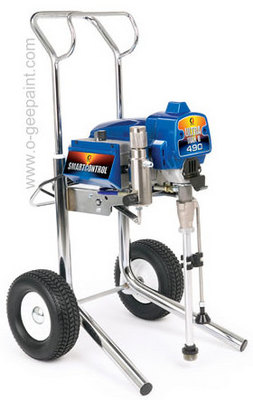
The unit that Graco has recommended is the Graco Airless Model 490. This unit handles an output of 0.5 gallons per minute and larger. This equipment can generate up to 3000 psi (well within the range of what we need).
Applicators can use a range of fan pattern tips:
- Model 513, 514, 515, 516 and 517 use a 12 inch wide tip
- A 24 inch fan pattern tip is also available (Model WR1221)
Approximate atomization should be as follows:
- Microbloc FSP, OSR, MMR, DC - use 1000 psi setting to start
- Microbloc MSP - use 2000 psi setting to start
NOTE: Full formal testing will soon be available from Graco Equipment.
************************************************************************
DON'T TAKE CHANCES! READ THE MATERIAL MANUFACTURER’S RECOMMENDATIONS. IF IN DOUBT, CONSULT YOUR MATERIAL SUPPLIER TO BE SURE.
Never Treat Any Injection Injury as a Simple Cut. If Injury Occurs, Obtain IMMEDIATE Attention. Be Prepared to Inform the Doctor What Fluid Was Injected.
Airless Spray Painting Suggestions and Techniques
A good airless spray application is the result of many factors: Surface preparation [which includes cleaning and de-greasing], priming, material compatibility, quality finish product and correct application technique ... all are important to the finished results.
The key to all good applications is a good spray gun technique. The finished results are what the client will look at and base his opinion on. Your skill and abilities are as important as good equipment and good paint. Proper application techniques can easily be learned by using the following simple guidelines.
If you are not familiar with the basic spray techniques we recommend that you study this portion of the manual and practice the techniques shown. Practice your technique on scrap cardboard or old newspaper until you feel confident.
For excellent results, read and practice these techniques:
1) Always strain all paint through a strainer bag. The most common reason for airless sprayers to malfunction is foreign matter jamming the valves or plugging the tip. Always strain the paint before putting through the pump.
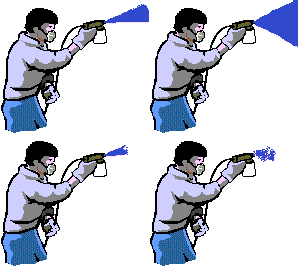
2) Always spray at lowest pressure setting to provide a uniform spray fan (fig. 1). See "Setting Up to Spray" on the Application Page for this tool.
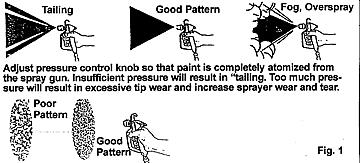
3) Adjust pressure control knob so that paint is completely atomized from the spray gun. Insufficient pressure will result in "tailing." Too much pressure will result in excessive tip wear and increase sprayer wear and tear.
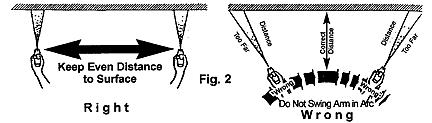
4) Always spray at right angles to the surface being sprayed (fig. 2.). Angling or arcing the nozzle toward the surface will cause uneven coverage and excessive overspray.
5) Always hold spray gun 12-15" from surface (fig. 3.). Too close and the fan width will be reduced and material will be applied too heavily (runs). Too far from the surface and you will have excesssive overspray and light coverage (transparent).
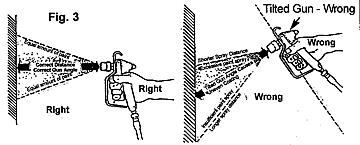
6) Always move the gun parallel to the surface being sprayed, at a consistent speed. This avoids uneven coverage (thick or thin areas).
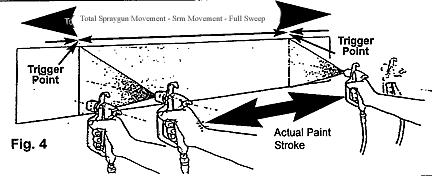
7) Always start the spray stroke before triggering the gun and release the trigger before completing the stroke (fig. 4). This avoids heavy build-up of paint at either end of the spray stroke.
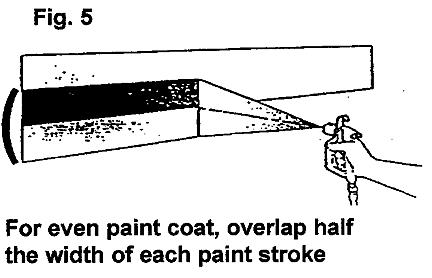
8) Always lap your spray pattern by one half (fig. 5). This assures full coverage of the surface being painted.